
Geothermal energy:
an eco-friendly source of cooling and heating
Geothermal heating and cooling solutions provide efficient and environmentally friendly systems for buildings of all sizes.
Fossil fuels such as oil, coal, or natural gas are finite resources that were formed by natural processes in the earth over millions of years. Once used, they cannot be replaced. As our society has become increasingly dependent on these energy sources over the past hundred years, environmental pollution and resource exploitation have accelerated. This highlights the need to seek renewable and environmentally friendly energy sources.
In this context, alternative sources such as solar and geothermal energy are gaining increasing importance.
Why is geothermal energy the future?
- Eco-friendliness – no CO₂ emissions or environmental pollution.
- Renewability – geothermal energy is available 24/7/365.
- Multipurpose use – works for both heating and cooling.
- Ideal energy source for surface heating systems – low-temperature systems pair effectively with geothermal installations.
- Cost-effectiveness – reduces heating and cooling costs, allowing savings of up to 75% compared to traditional systems.
- Versatility – suitable for both private homes and commercial buildings.
- Solution flexibility – options for horizontal, vertical, trench, and water collectors depending on site conditions.
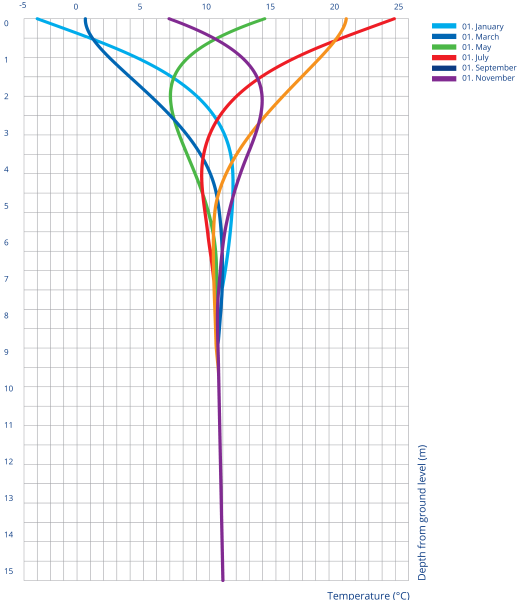
Chart 1 – Soil temperature variation depending on depth and season.
How does a geothermal heat pump work?
- Collector loop (horizontal, vertical, basket-shaped, or water-based) – pipes buried underground through which the heat carrier circulates.
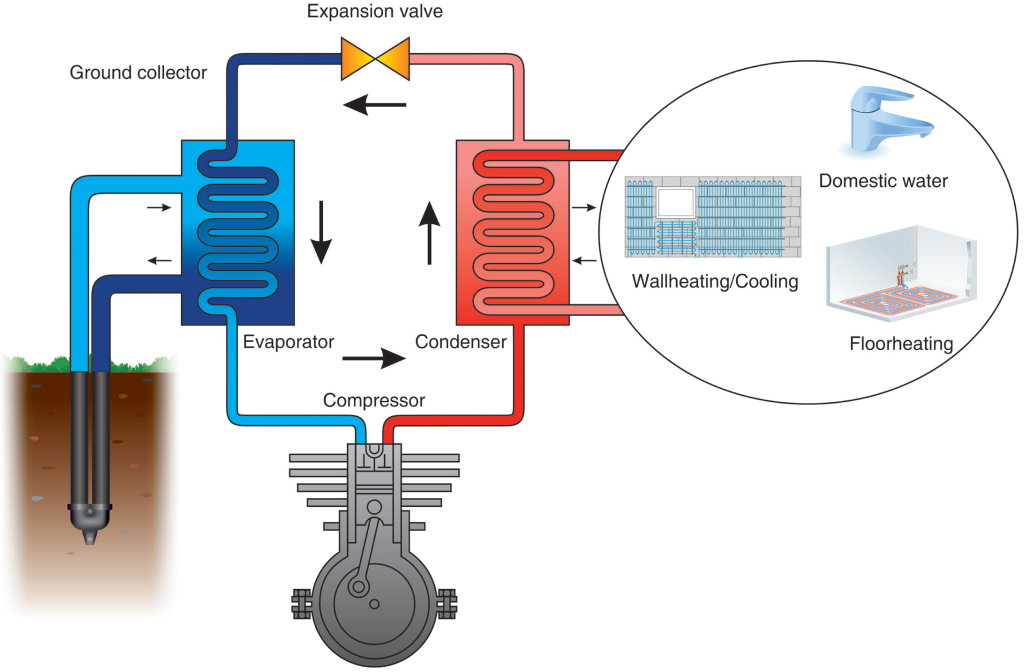
- Heat pump – converts the earth’s energy into useful heat or cooling for the home.
- Low-temperature heating system – distributes heat throughout the house (underfloor heating, fan coils, or low-temperature radiators).
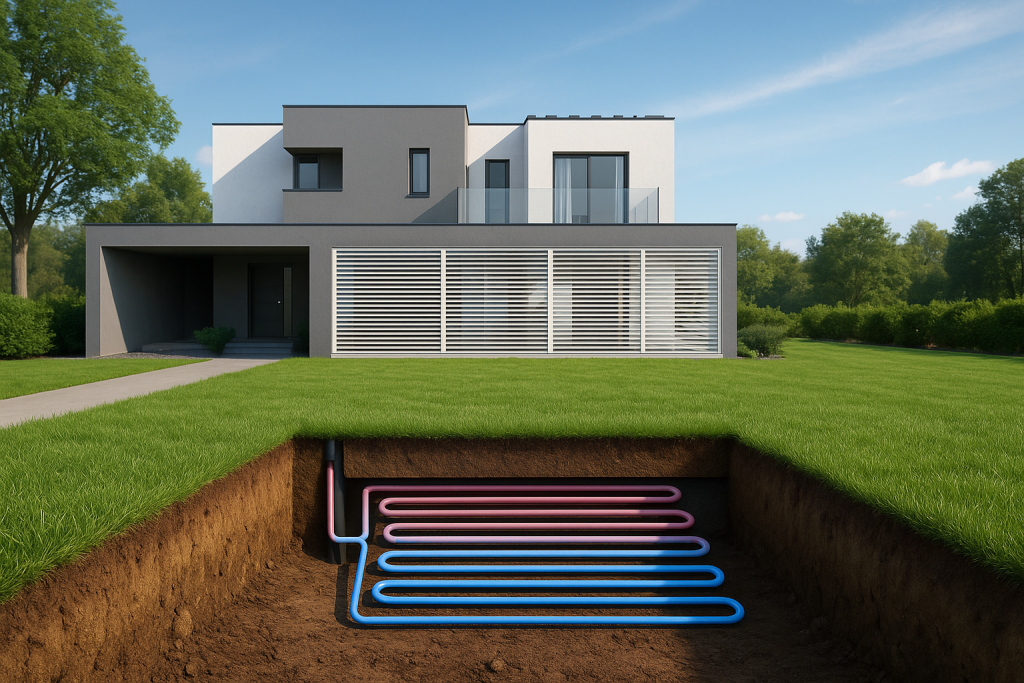
Horizontal collector
Horizontal collectors are the most commonly used method for transferring the earth’s energy to a heating/cooling source. They consist of pipes buried horizontally at a depth of approximately 1.5 meters.
Due to their proximity to the surface, the performance of horizontal collectors varies depending on the season. The heat extraction per cubic meter of soil by horizontal collectors is relatively low.
Vertical collector
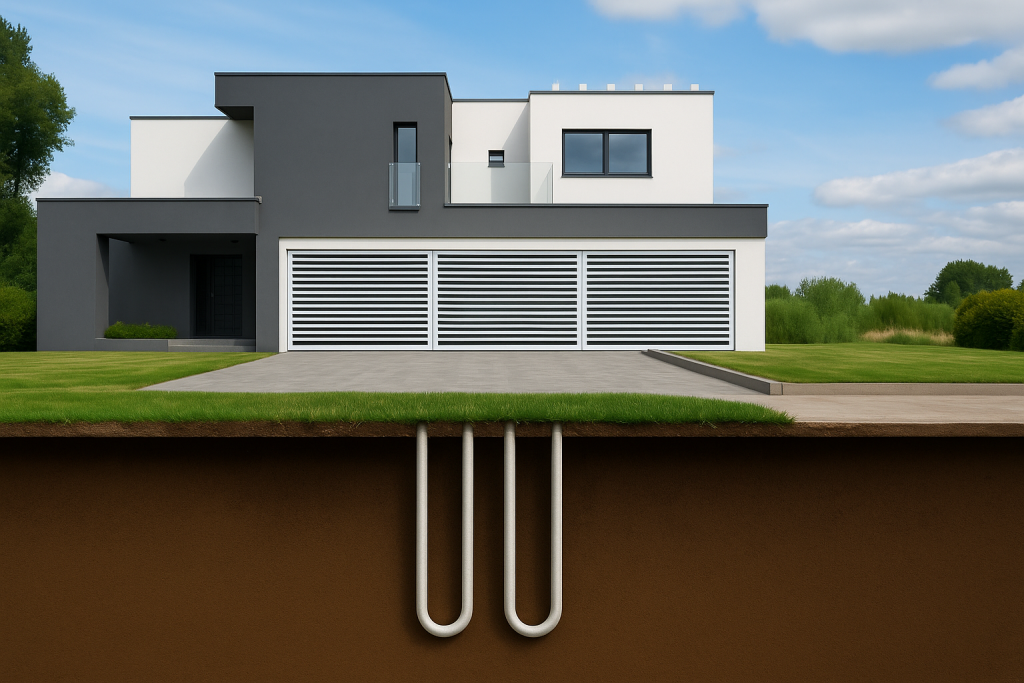
If the required space for installing a horizontal collector system is unavailable, vertical collectors can be the optimal solution.
Vertical collectors consist of one or more supply and return pipes installed vertically into the ground, typically about 100 meters deep, though greater depths are possible.
Vertical collectors can be used in almost all types of landscapes or soil conditions.
Basket-shaped or trench collectors
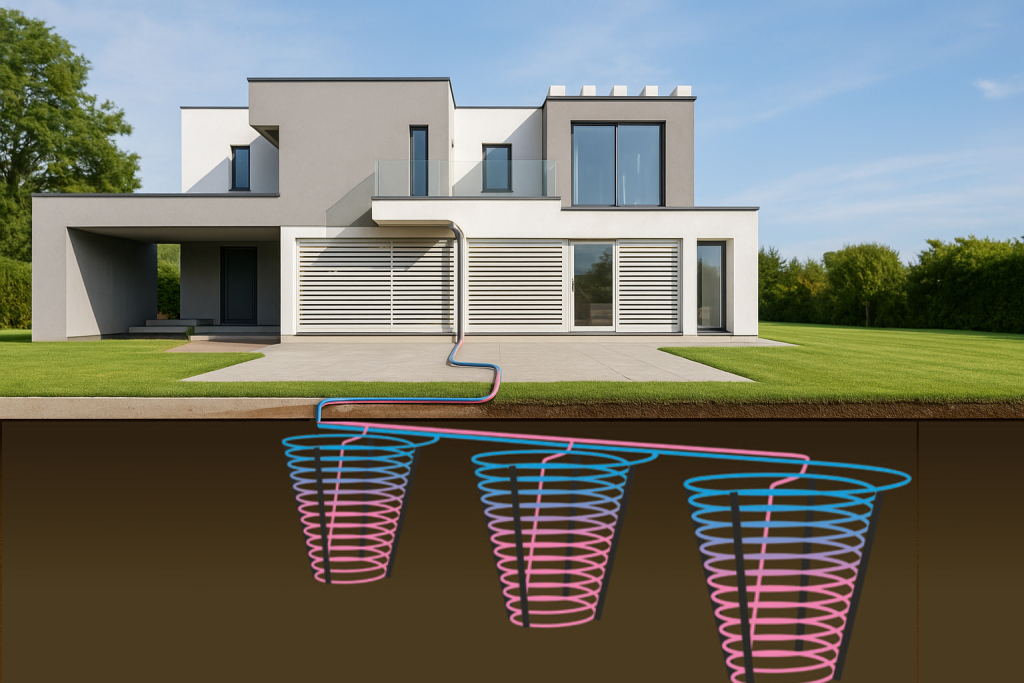
In the case of basket-shaped collectors, pipes are installed in a basket shape at a depth of several meters underground.
Trench collector pipes are buried horizontally, but unlike true horizontal collectors (where pipes are laid side by side), they are laid parallel to each other.
The burial depth is approximately two to three meters. This collector method can be used when there is insufficient surface area for installing a horizontal system.
Groundwater, lake, or river collectors
Open loops pump natural water from a well or water body (lake, river) into a heat exchanger inside the heat pump, then return the water back to the source.
The supply and return lines must be placed far enough apart to ensure thermal recharge of the source.
Запитати в ChatGPT
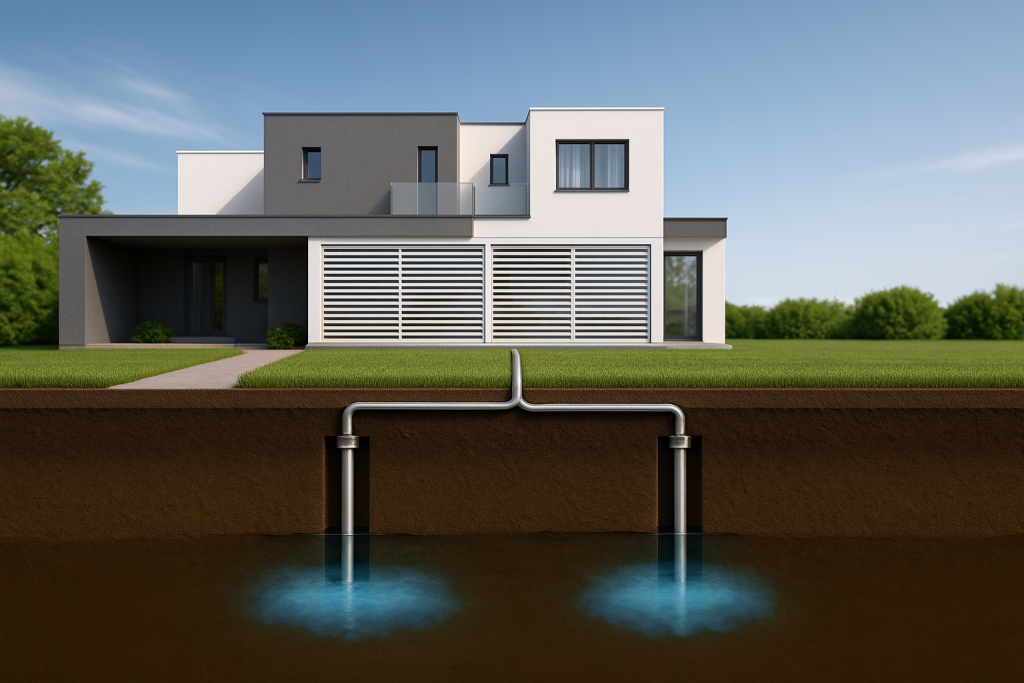
The heat carrier circulating in the loop heats up (or cools down) as it adapts to the soil temperature. The heat pump compresses this flow, raising it to the required temperature for heating or cooling.
Where and how does Pyramis apply geothermal systems in private houses and cottages?
The Pyramis team views geothermal energy as one of the most efficient technologies for creating energy-efficient, autonomous, and comfortable homes. We understand that every site and project is unique, so we select solutions based on specific conditions:
- For country houses with large plots – horizontal collectors, as they require significant space. This is the most cost-effective option.
- For sites with limited area – vertical collectors, which ensure stable system performance regardless of weather conditions.
- For sites with water bodies – groundwater-based loops, allowing the use of natural resources to reduce heating and cooling costs.
- For homes with high energy efficiency standards – hybrid systems, where geothermal pumps are complemented by solar panels, backup batteries, and automated climate control systems.
Our approach allows reducing heating and air conditioning costs, increasing comfort levels, and decreasing dependence on traditional energy resources.
We know how to make your home energy-efficient
Technologies are evolving, and a modern private home can no longer be built according to 20-year-old standards. Today, it is important to use energy consciously, reducing costs and increasing comfort.
The Pyramis team knows where and how to best apply geothermal energy, taking into account the unique features of each site and building. We keep up with technological developments and understand which solutions will remain relevant in the future.
If you want your home to be warm in winter, cool in summer, and economical year-round, we will help you choose the optimal geothermal heating and cooling system.
WE THINK AHEAD
We don’t just design engineering systems.
We create life infrastructure that works seamlessly, delivering maximum comfort, stability, and control.
If you're looking for solutions that will remain relevant not only today but also in the future — let’s talk about your project.