
PERLITE:
lightness, reliability and energy efficiency
Perlite is a natural mineral — a type of volcanic glass — that, when heated to high temperatures (850–1200°C), rapidly expands and becomes porous, increasing in volume several times. In construction, expanded perlite is used for its low weight, excellent thermal insulation, and moisture-regulating properties.
Use of perlite in construction
Perlite is widely used in various construction systems, including:
- Thermal insulation – used as a filler in lightweight concrete and plaster mixes, as well as in loose-fill form for insulating walls, roofs, and floors
- Sound insulation – its porous structure effectively absorbs noise
- Fire-resistant structures – used in fireproof plasters and cladding to reduce the risk of fire spread
- Moisture control and filtration – the material’s porous nature allows it to absorb and release moisture, helping to maintain a healthy indoor climate
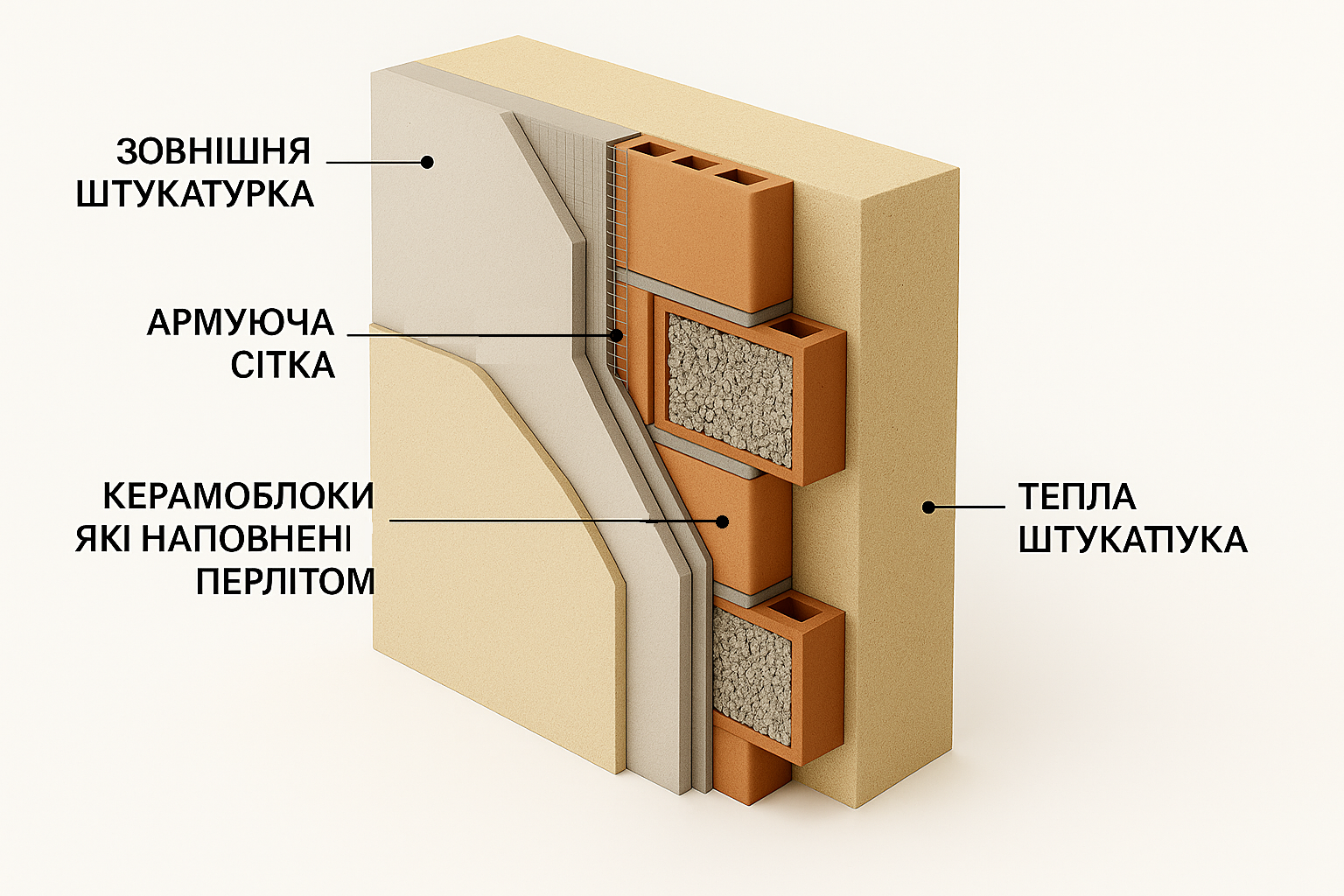
Certainly, there are other materials used as insulation in construction. In our region, these include mineral wool and expanded polystyrene (EPS, XPS). Since at Pyramis we focus on long-term and stable performance, comparisons of these materials should be made with regard to the lifespan of the building. The main characteristics of these materials are presented in the table.
| Property | Perlite | Mineral wool | Polystyrene foam (eps, xps) | |
| 1 | Thermal conductivity (w/m*k) | 0.05 | 0.035 | 0.032 |
| 2 | Density (kg/m³) | 50 | 15 | 20 |
| 3 | Vapor permeability (mg/(m*h*pa)) | 0.5 | 0.3 | 0.01 |
| 4 | Fire resistance | high (non-combustible) | high (non-combustible) | low (combustible) |
| 5 | Moisture impact | sensitive, requires protection | absorbs moisture, loses properties | does not absorb moisture |
| 6 | Dimensional stability | stable | may compact | stable |
| 7 | Durability (years) | 20 | 15 | 25 |
| 8 | Settling over time | small effect possible when used as loose fill | may settle and lose effectiveness | no |
| 9 | Environmental friendliness | natural material | partially natural | synthetic material |
As seen from the table, perlite and mineral wool are the most suitable materials for insulation if you care about the environmental friendliness and safety of your home.
Now, let’s consider the impact of key factors on these materials.
The effect of time on the properties of perlite and mineral wool
1. Perlite
What happens over time?
- Settling: If perlite is used as loose fill (for example, in wall cavities), it may gradually settle and compact, increasing its density and reducing its thermal insulation properties.
- Hygroscopicity: Perlite absorbs moisture, which also worsens its thermal conductivity. When saturated with water, its properties can deteriorate several times. However, with proper moisture protection, this factor can be minimized.
- Mechanical fragility: The material is quite fragile, so mechanical impacts (such as vibrations in structures) can cause particle breakdown, which also affects its efficiency.
Thermal conductivity stability
If perlite is protected from moisture and mechanical impact, it retains its properties virtually unchanged for decades.
With poor moisture protection, thermal conductivity can increase 2–3 times, making insulation ineffective.
2. Mineral wool
What happens over time?
- Settling and shrinkage: Depending on the quality of mineral wool and installation technique, the material may “settle” over time, leading to voids and reduced thermal insulation. This is especially critical for horizontal insulation (attics, roofs).
- Moisture accumulation: Mineral wool does not absorb moisture but can retain it in the fibers if ventilation is compromised. In this state, its thermal conductivity increases, and over time this can lead to mold growth and material degradation.
- Compression: Wool can compress under its own weight or external pressure, reducing its volume and thermal insulation properties.
Thermal conductivity stability
With proper installation and moisture protection, mineral wool retains its properties for 15–25 years without significant changes.
If the wool becomes wet or compressed, its efficiency drops, and replacement may be necessary.
Conclusions:
- Perlite is durable if protected from moisture and mechanical damage. However, when used as loose fill, settling should be taken into account.
- Mineral wool is more sensitive to mechanical deformation and requires moisture protection but, if properly installed, lasts 15–25 years without significant changes.
- In conditions of high humidity and poor ventilation, both materials lose effectiveness, but perlite recovers its properties after drying, while mineral wool does not.
If long-lasting and stable insulation is important, perlite is the more preferable solution when properly protected.
The influence of vapor permeability of perlite and mineral wool
| Material | Vapor permeability coefficient, mg/(m·h·pa) | Vapor permeability |
| Perlite | 0.5 – 1.2 | high |
| Mineral wool | 0.3 – 0.6 | medium |
The higher the coefficient, the better the material allows water vapor to pass through.
How does this affect the structure?
Perlite has high vapor permeability, so moisture can easily pass through it. This helps keep the structure dry and reduces the risk of condensation buildup. However, if the building envelope does not allow moisture to escape outward, perlite may absorb water, increasing its thermal conductivity.
Mineral wool also allows vapor to pass, but to a lesser extent. If moisture enters the wool layer and cannot escape, the fibers begin to retain water, significantly increasing the material’s thermal conductivity.
How does vapor permeability affect insulation thermal conductivity?
1.High humidity = high thermal conductivity
- If insulation becomes wet, its thermal conductivity can increase 2–4 times, making it much less effective.
- For example, mineral wool in a dry state has a thermal conductivity of 0.035 W/m·K, but when wet it can reach 0.1–0.15 W/m·K.
- Perlite in a dry state has a thermal conductivity of 0.05 W/m·K, but when wet — up to 0.12 W/m·K.
2.Incorrect vapor permeability can cause condensation
- If insulation has higher vapor permeability than the outer layer, moisture may become trapped inside the structure.
- For instance, if walls have low vapor permeability (such as polystyrene coating), the insulation (whether perlite or mineral wool) may get wet due to the inability to evaporate moisture outward.
Conclusions:
- Perlite is more suitable for structures where natural moisture circulation is important. It allows vapor to pass well, but must be protected from getting wet.
- Mineral wool works efficiently if there is good ventilation and protection from condensation. When wet, it quickly loses insulating properties and often needs replacement.
- Vapor permeability across the entire structure must be properly balanced, or the insulation will begin to retain moisture, reducing its effectiveness.
Conclusions on the use of perlite in construction
Based on the comparison of insulation materials in terms of thermal conductivity, durability, moisture resistance, and vapor permeability, the key advantages of using perlite in construction include:
- Environmental friendliness – Perlite is a natural material, unlike polystyrene. It does not release harmful substances and contains no synthetic components.
- Fire resistance – The material is non-combustible and does not support flame spread, making it a safe choice for thermal insulation.
- High vapor permeability – Allows walls to “breathe,” reducing the risk of condensation and mold formation inside the structure. This is especially important when insulating brick or ceramic block houses.
- Durability – When properly protected from moisture, perlite retains its thermal insulation properties for 20 years or more.
- Dimensional stability – It does not shrink, settle, or lose shape over time, unlike mineral wool.

When should perlite be used?
- In constructions where vapor permeability is important (e.g., brick or ceramic block houses).
- In projects that require a natural and environmentally friendly material.
- In buildings where high fire safety is a key requirement.
When might perlite be less suitable than other materials?
- In high-humidity conditions without reliable moisture protection.
- In projects where minimal thermal conductivity is critical (EPS and XPS are more efficient for insulation).
- When minimizing insulation costs is a priority — polystyrene is usually the cheaper option.
WE THINK AHEAD
We don’t just design engineering systems.
We create life infrastructure that works seamlessly, delivering maximum comfort, stability, and control.
If you're looking for solutions that will remain relevant not only today but also in the future — let’s talk about your project.